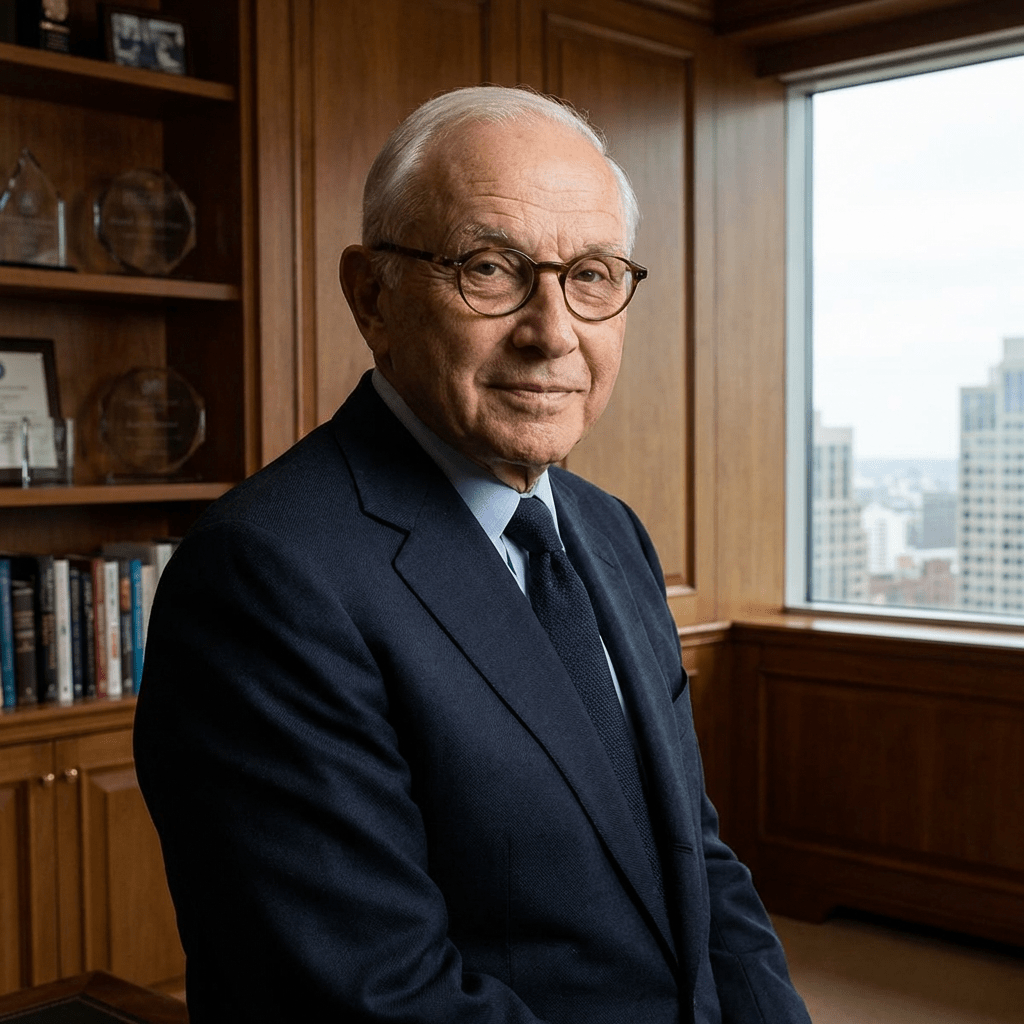
Part I: Leslie Wexner
The genesis of the “Epstein Class” cannot treat Jeffrey Epstein as its origin. Understanding the figuration “Epstein” requires us to follow at least three different, if intertwined, axes:
- Ghislaine Maxwell: The only other person convicted of crimes associated with Epstein. What is remarkable in her court case is the complete absence of any documentation or evidence related to Jeffrey Epstein’s emails and other correspondence. The fact that Ghislaine Maxwell is the daughter of the late Robert Maxwell—who was an asset of Mossad—has been completely neglected in her prosecution during Merrick Garland’s tenure as Attorney General.
- Donald Trump: His rise to power and his role in the destruction of Western hegemony cannot be understood without his close friendship with Jeffrey Epstein. Despite extreme measures to protect him from being exposed as a core pillar of the Epstein Class, multiple trajectories have left traces suggesting that Trump is indeed owned by at least two foreign powers: Russia and Israel.
- Leslie Wexner: The individual who elevated Jeffrey Epstein’s standing and influence by granting him power of attorney in 1991. This gave Epstein nearly total control over Wexner’s vast fortune, allowing him to hire people, sign checks, buy and sell real estate, and make legal and business decisions on Wexner’s behalf without requiring a second signature. Epstein was also appointed as a trustee of the Wexner Foundation and was deeply involved in managing Wexner’s charitable endeavors and private assets.
Since the Trump and Maxwell links are more visible and well-known, I want to dig deeper into the Leslie Wexner axis, starting with the Wexner Foundation. This organization operates as a charitable foundation, but its work is rather peculiar. Its main pillars involve supporting Jewish leadership in the USA and the Israeli public service. This primarily entails financial support for the already privileged. In late 2023, the Wexner Foundation officially severed its long-standing partnership with Harvard University, citing a “dismal failure” of the university’s leadership to respond adequately to antisemitism following the October 7 attacks. Consequently, the charitable focus of the Wexner Foundation also includes pressuring universities to support Zionism.
This highlights that, as a pillar of the Epstein Class and similar to Ghislaine Maxwell, Leslie Wexner places the interests of the Zionist project at the heart of funding the creation of the political class in the USA. While operating under the banner of charity to obtain tax breaks is completely legitimate in a political culture where most politicians are bought and paid for, the same cannot be said of the source of Wexner’s wealth.
Wexner’s background is—like that of Jeffrey Epstein—apparently modest. However, the acquisition of Victoria’s Secret twenty years after entering the retail business suggests that wealth was generated primarily through acquisitions, which would require other sources of venture capital. Wexner’s growth was inextricably linked to the rise of the American shopping mall. His most significant mentor was A. Alfred Taubman, the son of Jewish immigrants from Poland who became a billionaire mall developer and a supporter of the Wexner Foundation. This provides the necessary link between Wexner and real estate.
Taubman is himself the protégé of another. One of the most critical figures in Taubman’s early career was Max Fisher, a legendary Detroit financier and philanthropist (who also served as a mentor to Leslie Wexner). Born in 1908 to Russian Jewish immigrants, Max Fisher became a billionaire in the oil and real estate industries. This establishes the link to another powerful lobby. However, his “enabling” power came less from his liquid cash and more from his role as a “Quiet Diplomat”—a bridge-builder between the American corporate elite, the Republican Party, and the State of Israel. Often referred to as the “Dean of American Jewry,” Fisher was the primary conduit between Washington and Jerusalem; he understood how to navigate government bureaucracy and international policy. For real estate developers like Taubman, whose projects relied on highway approvals and zoning, or for retailers like Wexner, whose supply chains relied on international trade deals, having a mentor who could call the President was the ultimate form of risk management. Fisher also had close connections with Henry Ford, who functioned as a conduit for inviting rising Jewish business elites into the closed circles of the so-called “old money.”
The Fisher–Taubman–Wexner triad represents a clear emergent Jewish business elite that binds the fossil fuel industry, real estate, and the brand-retail sector. There are also clear links to the Rothschild family, who owned the Paz Oil Company before selling it to Fisher. At that time, Paz held a monopoly over Israel’s oil and petrochemical infrastructure. Max Fisher, in partnership with Swiss-Israeli financier Tibor Rosenbaum, bought a controlling interest in Paz from the Rothschilds. This Swiss link becomes of peculiar interest when investigating the infamous Meyer Lansky. Fisher served as the Chairman of the Board of Governors of the Jewish Agency for Israel for decades. In this role, he worked directly with various members of the Rothschild family (who were major historical patrons of the agency) to manage the massive capital flows and diplomatic efforts surrounding the Soviet Jewry movement and Israeli economic development.
So far, I have only conducted a superficial genealogy of the financing of Leslie Wexner’s empire. Wexner’s interest in building a Jewish political-economic American and Israeli elite does not emerge from a vacuum; it is written into the genealogy of the “New Money” that the Fisher–Taubman–Wexner trajectory accumulated. Thus, the money that Jeffrey Epstein was allowed to play with—to buy mansions, invest in projects, acquire jets and helicopters, and purchase security equipment—is derived, directly or indirectly, from a long line of wealth accumulation.
This analysis is not about discrediting these prominent members of the Jewish-American elite. There is no doubt that these men were highly intelligent. Alfred Taubman, for example, had an excellent understanding of retail psychology, and Leslie Wexner turned Victoria’s Secret into a high-street brand by understanding the risks of female embarrassment regarding sexualization and managing this by associating the brand with an “aristocracy of taste.” The sexual dimension of lingerie retail is surprisingly absent in many accounts of Jeffrey Epstein’s antics. A brand like Victoria’s Secret is an excellent front for recruiting teenage girls aspiring to become models.
The “sexual dimension” of these industries is not just a subtext; in the case of Jeffrey Epstein, it was a documented operational tool. While traditional retail focuses on moving inventory, Epstein leveraged the prestige and visibility of Leslie Wexner’s brands to create a “recruitment pipeline” that mimicked legitimate talent scouting. Multiple accounts and legal filings (including declassified FBI files released in early 2026) confirm that Epstein used his proximity to Leslie Wexner to pose as a talent scout. Epstein would approach aspiring models, claiming he had the power to get them into the Victoria’s Secret Fashion Show or catalogs. Because Wexner was his only client and Epstein had total power of attorney, he could inhabit the corporate spaces of L Brands with an air of absolute authority. In 1997, an aspiring model, Alicia Arden, reported to the police that Epstein lured her to a hotel room under the guise of an audition for Victoria’s Secret, where he then assaulted her. Recent congressional depositions of Wexner (February 2026) revealed that several Victoria’s Secret executives had warned Wexner as early as the mid-90s that Epstein was “creeping out” models and posing as a scout, yet no formal action was taken to bar him from the company’s orbit.
Beauty pageants—such as Miss Universe and Miss Teen USA—serve as a high-visibility scouting mechanism. For someone like Epstein or Trump, these events provided a concentrated pool of individuals whose primary goal was entry into the “glamorous professions.” Ownership of a pageant (as Trump had with Miss Universe) or sponsorship of one provides legitimate “backstage” access. Trump famously joked on The Howard Stern Show about “getting away with” going backstage while contestants were undressed because he was the owner. In 1993, Trump and Epstein reportedly hosted a private “calendar girl” event at Trump’s Mar-a-Lago for 28 contestants of the American Dream Calendar Girls competition. Witnesses, including model Stacey Williams, have alleged that this was a shared social environment where young women were “vetted” by both men.
With the passage of the Epstein Files Transparency Act and the subsequent release of FBI documents in late 2025 and early 2026, the link between “model scouting” and “trafficking” has become a central focus of legal scholars. The files highlight “fixers” like Daniel Siad, a model scout whose leaked emails show he spent a decade vetting young women for Epstein based on specific physical measurements and “youthfulness,” often under the banner of legitimate casting for brands like Victoria’s Secret.
 Disaffected Sociology
Leave a comment