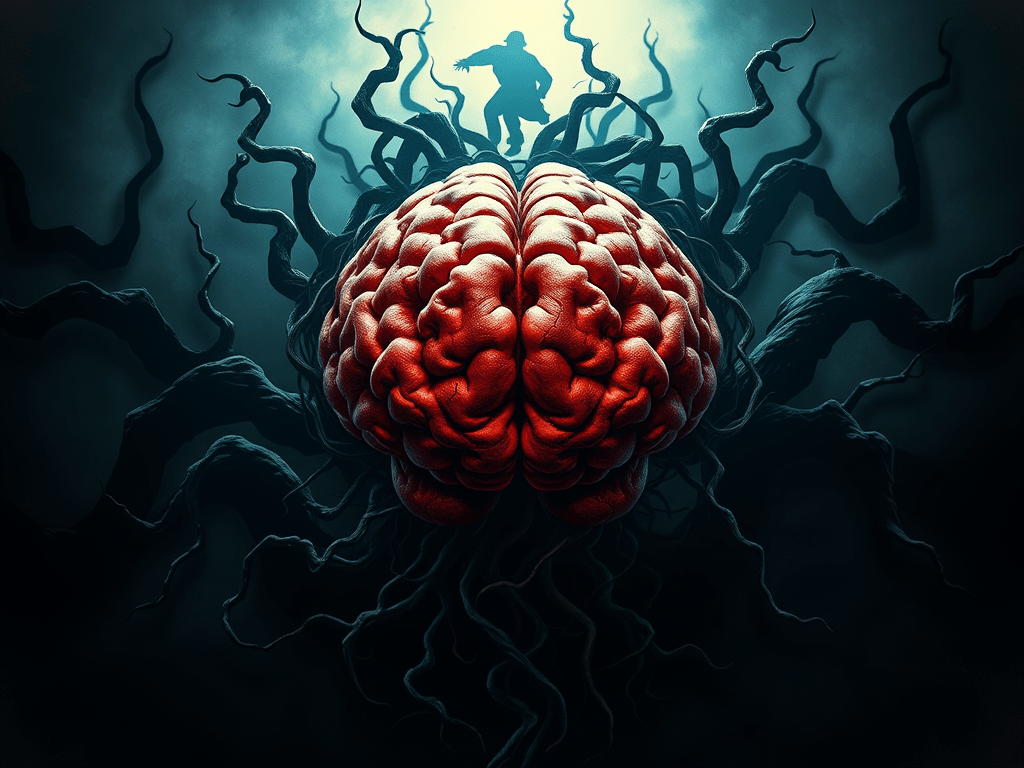
The Encephalopathic Condition of Fascist Culture
It is well known, that for right extremist movements such as MAGA, Antifascism – better known as AntiFa poses a huge problem. This is logical, because AntiFa exposes their fascism and calls it by its name. Being Anti-AntiFa automatically makes one more or less a fascist, but even the lesser extent of being fascist (such as the Social-Democratic Party who in 1932 in Germany voted with the National Socialists to proscribe the Communist Party) is still enabling fascism. Because Facism is a force of destruction directed against life itself, it will always seek to expand and contaminate. It does not tolerate neutrality. If you are not anti-fascist, you are a by default a fascist.
As the only effective resistance to fascism is antifascism, it is clear why fascist movements seek to eliminate it. The first step to its elimination is semantic. Being anti-fascist is semantically associated with left-wing-extremism. One of the earliest signs of this semantic practice is the suggestion that left-wing-extremists are overusing the word fascism as a catch-all for anything they disagree with. This creates the suggestion, that there is a neutral zone between fascism and antifascism of entities that are neither fascist, nor antifascist. But as not being antifascist by default means that one believes that coexistence with fascism is possible, one is already preparing to tolerate or even accommodate another fascist takeover.
The first step is a seemingly innocuous semantic intervention: fascism is a marginal political philosophy that does not require naming and exposing. It is a very special word that must be reserved for very special, extraordinarily radical phenomena, preferably exclusively related to the past. This is an extremely important part related to “Holocaust Education”. If one can impose the view, that fascism is exceptional and not systemic, one needs exceptional evidence. Thus, in the context of Holocaust Education, fascism is most emphatically associated with the extermination camps of the Third Reich, which operated between 1941 and 1945. The fact that the Third Reich itself had already come into being in 1933 and the fact that in Italy, Mussolini’s Fascist Party was in power from 1922 to 1943 seem to be of less interest.
The semantic association between antifascism and left-wing extremism thus obfuscates an extremely important aspect of fascism: its slow rise to power. By associating it with extermination camps, the systemic, insidious and virulent nature of fascism becomes unrecognizable. We no longer understand how it festered under the surface, how it became encephalopathic. To do that, we should not look at political discourse but at cultural practices. It is a slow process that unfolds in small steps, related to mostly innocuous and banal issues, where changes are considered a threat. Considering certain banal issues as a risk amplifies the sense of threat, but also amplifies the necessity of doing something about it. For example, in Russia, homosexuality was criminalized (by the Tsarist regime), de-criminalized in 1922 (by the first communist government under Lenin), re-criminalized in 1933 (under Stalin), de-criminalized in 1993 and recriminalized again in 2013.
The last criminalization officially focused on “propaganda” and thus targeted “speech” rather than “acts”. When in November 2023, the Russian Supreme Court declared the international LGTBQ+ movement a “terrorist organization”, it made it abundantly clear, that the term “terrorism” can now be applied to anything that one disagrees with, in particular affecting modes of expression. This perfectly mirrors how under the various Likud regimes in Israel, the term terrorism also started to become a catch-all for anything that might be considered opposed to the State of Israel and how similarly today, Antisemitism has become a catch-all for any expression critical of Zionism, including its vociferous support for genocide, war crimes and ethnic cleansing.
Fascism has to be treated not as a political ideology, because it isn’t, but as an encephalopathy, a brain disease. It coagulates around the insinuation of specific risks, almost always phantom risks. The importance of phantom risks is above all that they are generally never experienced as such but only spread via hearsay and rumours. This is how under Joseph Göbbels, the Nazi-propaganda was able to associated all kinds of social ills with the presence of Jewish people as the enemy within. The fact that these associations could not be experienced amplifies their effectiveness because the absence of evidence can be explained by the invocation of conspiracies. For example, the absence of evidence that Greta Thunberg is associated with Hamas, did not deter Netanyahu and his followers to propagate this as an excuse to illegally board and seize the Global Sumud Flotilla in what would in any other circumstance be considered an act of piracy, i.e. a crime. However, since it is Israel and since there is this unproven accusation of terrorism, international law is once again being exposed as meaningless.
The shamelessness with which in Russia homosexuality has been criminalized is exactly the same shamelessness with which western governments justify the genocide in Gaza. Both are only possible because of the spread of fascism as a collectivized brain disease. The epidemic of fascism bypasses ideo-logy because it bypasses logic. It feeds on hyperstitions: phantom risks being turned into actual threats.
Thus, the semantic shift to associate Antifascism with left-wing-extremism is to be understood immunologically. As fascism spreads and infects the brains of an increasing number of people, its triggering of antifascist activities, which is a normal immunological response, is slowly being turned into an autoimmune disease. The Russian invasion of Ukraine and the genocide in Gaza are two examples of “Immunitas” (Esposito) aggressively destroying the mechanisms that uphold a sustainable “Communitas”.
The encephalopathic nature of Fascism is not a metaphor, because fascism is not a political ideology; it is a state of neurosis that festers through a combination of two forces: fear and cowardice. The fear of homosexuality in Russia was actively cultivated to amplify the opportunistic politics of scapegoating, Because people lacked actual experiences with that which they were supposed to be afraid of (the homosexualization of their sons and daughters?), these fears had to be cultivated externally, by means of alienation. Public media and entertainment have always cultivated alienation; what was only needed now is a scapegoat to take the place of the ultimate villain. Whereas in Russia, this was the “gay propagandist”, in Zionist Israel it was always the Palestinian, as Palestinians were natives to the land that the Zionists wanted to claim.
There are of course many other encephalopathic strategies associated with the spread of fascism as a cultural autoimmune disease. For example, in the USA it focuses on transgender phenomena as well as “Mexicans”; in Germany it evolves around the idea that changes in the use of the German language to accommodate female forms are a threat to their national identity; in France and the Netherlands it focuses on the figure of the young, male Muslim of North-African descent. These phenomena are phantom risks that are being amplified by “news reports” about bad things being done by them to “ordinary people”. The best evidence of this being encephalopathic is provided by news journalism itself, as it is always under pressure to affirm the possibility of phantom risks being real threats, even if the evidence forces them to deny it in the end, which in some cases might actually lead to rectifications. These rectifications, however, do not inhibit but actually amplify the encephalopathic contamination, as fascism has always-already undermined the entire possibility of a public sphere (e.g. “the lying press”, “fake news media”, “Lügenpresse”, etc).
 Disaffected Sociology
Leave a comment