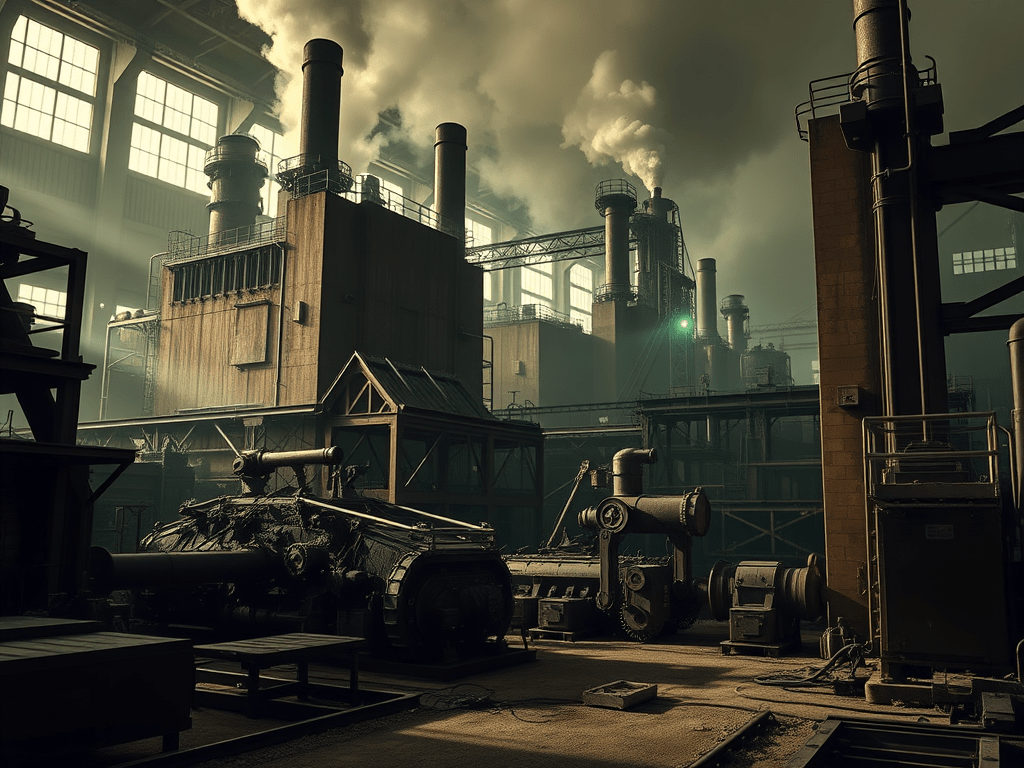
The case of Rheinmetall AG.
Thyssen and Krupp are not the only current major German arms manufacturers with a history of alignment with the Third Reich. It is well documented, that Rheinmetall AG, one of Germany’s largest arms manufacturers today, was deeply integrated into the Nazi war machine and benefited from both the war efforts as well as forced labour, including those from concentration camps.
Founded in 1889, Rheinmetall was a key arms producer for the German Empire and the Weimar Republic. In the 1930s, as Hitler came to power and began to remilitarize Germany in violation of the Treaty of Versailles, Rheinmetall became one of the core suppliers of weapons to the Nazi military. In 1933, the same year Hitler took power, the company was partially nationalized and came under greater government control as the Nazi regime expanded military production. Throughout the 1930s and 1940s, Rheinmetall produced a wide range of weapons systems for the Wehrmacht, including: Artillery pieces, Anti-aircraft guns, Ammunition, Tank components (in collaboration with other firms). In 1936, Rheinmetall merged with the steelworks of August Borsig GmbH, forming Rheinmetall-Borsig AG, further expanding its industrial capacity under Nazi rule.
After the defeat of Nazi Germany, Rheinmetall’s arms production was banned by the Allied occupation. The company shifted temporarily to civilian goods (like office equipment), but by the 1950s and especially during the Cold War, it re-entered the defence sector, supported by the West German government and NATO. As with so many aspects of the so called “Denazification of Germany”, the rehabilitation of those complicit in war crimes and crimes against humanity was swift and unapologetic, as the fear of communism was (and still is) a lot greater than the disgust over fascism.
Today, Rheinmetall AG is a key producer of military vehicles, weapons systems, and ammunition, a major supplier to the German Bundeswehr and NATO allies; and Increasingly active in international arms exports, including to conflict regions. Rheinmetall has been at the center of public and legal controversies over arms sales to Saudi Arabia, despite the genocidal war in Yemen; indirect arms transfers to conflict zones through subsidiaries (e.g., in Italy or South Africa); lobbying for expanded export permissions from the German government; alleged circumventions of export bans by producing arms in third countries.
It should thus not come as a major surprise that the shares of Rheinmetall AG have exponentially increased in value. In mid‑2025, Rheinmetall’s share price soared past €1,900, peaking around €1,944 on June 2 (an all-time high), which meant a remarkable increase of nearly 290% since November 2024. The stock doubled in value in 2024, and doubled again in early 2025, a 12-fold rise in just over three years since early 2022, when the share price was below €100. The 2024 sales soared by 36%, reaching around €9.8 billion, with defence sales up approximately 50% year-over-year. Operating profit hit a record €1.48 billion, up 61%, with a margin of ~15.2% (projected to increase to ~15.5% in 2025). Order backlog surged to €55 billion, as demand from NATO and EU countries continues accelerated due to the proliferation of fears over Russian aggression as well as the growing realization (as for example shown in relation to the war in Ukraine) that the Trump regime has made the USA a very unreliable “ally”. For 2025, Rheinmetall forecasts 25–30% total sales growth, with its defense segment expected to grow by 35–40%.
German and EU defence budgets have sharply increased post‑Ukraine war, shifting procurement toward European firms—including Rheinmetall—supported by initiatives like the EU’s joint procurement loans and domestic production quotas. Analysts project further upside: Some envision Rheinmetall shares reaching €1,200–€3,000 by 2030 if defence spending hits 2–3% of GDP across Europe. That is, the company’s “performance” has very little to do with market dynamics, but relies completely on political decisions. This explains why they are very active as lobbyists.
By the end of 2024, roughly 57 % of shares were held by institutional investors such as BlackRock, the Vanguard Group, FMR LLC / Fidelity Management & Research, Capital Research & Management Company and Wellington Management Company LLP, while around 27 % were held by private shareholders. The profits from trade and dividends are enormous. It should come as no surprise that the arms industry and institutional investors have a shared interest in determining which political parties make up governments as their decisions drive the value of shares and the return on dividends. Naturally, they prefer governments that cultivate fears and anxieties over national security and thereby funnel taxes to private assets via “defence spending”.
This is the meat on the bone in the analysis of the relationship between risk-discourse and the politics of extortion. There is no clear break between the success of companies such as Thyssen, Krupp and Rheinmetall during the Third Reich and today. The corporatism then is very similar to the corporatism today. Corporatism is a better term to use than Fascism as the latter connotes hate-filled political aggression rather than the cold, calculated rationality of efficiency and profit-maximization. Corporatism offers big businesses opportunities to bypass free markets. By determining political decision-making in their favour, they do not have to worry about offering “value for money” nor do they have to worry about labour movements.
Recent noises uttered by aspiring corporatists such as Friedrich Merz and Katharina Reiche (both members of the “Christian” “Democratic” Union, which is neither Christian nor Democratic) claiming that the German work force is lazy and need to work longer hours, are clearly foreplay to further shifts towards corporatism. Of course, labour markets were never subject to supply-and-demand mechanisms. For those at the top, there is no real demand. Managers are grossly overpaid in relation to their added value. At the bottom, shortages of supply do not lead to higher wages, but to the kind of pressures that corporatists invoke: forced labour (which could include migrant labour, but also targeting people with disabilities or chronic illnesses).
Corporatists seek to increase austerity to force people to work longer hours under impoverished conditions. Corporatists also seek to deregulate housing markets to increase the anxieties over homelessness, with the added bonus that those who already have a lot, can use their capital to gain more wealth without having to work for it. Corporatists love to erode health care and health insurance provisions, so that the threat of illness becomes another means to enforce compliance.
In short: Corporatism is a political system that aligns risks with modes of extortion. The masses are extorted to work longer hours for less pay, edging closer to the poverty limits as the “costs of living” are driven upwards; or they are seduced to join the army and be prepared to sacrifice their lives to sustain the wealth of the few.
The comparisons between the Third Reich and “Western Democracy Today” are often vilified as hyperbolic and offensive. This, however, is exactly because in terms of both “facts” and “logic”, these comparisons are justified. The so called denazification of Germany was a total farce. Many war criminals and perpetrators of genocide never faced justice. Many of them were rehabilitated. The accumulation of wealth that was enabled by the corporatism of the Third Reich simply continued afterwards, but was renamed a “Wirtschaftswunder” (an economic miracle). Germany’s wealth today is still rooted in corporatism.
Even if one considers my accounts of the state of corporatism in Germany to be exaggerated, it is undeniable that the USA are accelerating its corporatist dismantling of the rule of law according to the principles of democracy. They are well under way in the repetition of history, and this time, there is no one to save us.
 Disaffected Sociology
Leave a comment