58. Right wing militia and the manosphere 4
However, rather than blaming incels for their embrace of toxic masculinity, we should at least have the courage to identify the structural conditions of this. Incels did not invent toxic masculinity and they certainly did not create the conditions of the crisis in masculinity that enabled toxic masculinity to become a favoured “solution” (which of course it isn’t). Incel culture is the psychic compost from which fascist libidinal aesthetics bloom, but its roots are in the loss of the self-evidence of masculine superiority, due to structural transformations of both the labour market and the public sphere.
Physical prowess through manual labour has become globally and domestically racialized. This is not just a matter of skin colour or ethnicity but is rooted more deeply in the body itself, in sweat, exhaustion, abuse and pain. Being working class has itself been racialized. This has led to an actual “white flight” from manual labour; alongside the deindustrialization of “the West” (where manual labour was exported to non-western countries) and the growing sense of obsolescence of a domestic male working class, also emerged the incentive to keep working class kids inside the school system for longer, without necessarily having any meaningful jobs for them afterwards. Young women were better equipped to deal with this due to the rise of low paid part time jobs in the retail and service sectors. The devaluation of manual labour also correlated with a second-order racialization, which is no longer tied to sweat, exhaustion, abuse and pain in general, but to skin colour, ethnicity, and foreign-ness in particular. The jobs associated with “white people” are tied to wearing nice suits, polished shoes, sitting on chairs, talking, typing, answering calls and emails etc. These are all associated with “effeminate” qualities, they emasculate manhood.
Alongside transformations of the labour market there are also transformations of the public sphere. A most obvious and easily recognized transformation is the presence of women. In the “West”, women are now much less confined to the private sphere as they used to be during the first three decades after the Second World War. Women are now also important political actors and women’s concerns over, not only the domains of reproductive health or sexual violence, but also wider concerns over notions that had until then played a minor part in public life, such as peace, equality, universal rights (e.g. in education), justice, ecological health, or the ethics of care, were articulated much more powerfully by politically organized women inspired by feminism. This has changed the nature of the political. Whereas before its feminization, the public sphere was very much forged in the image of Carl Schmidt’s Nomos of the Earth: territorializing the separation of friends and enemies in struggles over sovereignty and autonomy, the feminist intervention introduced “the stranger” as a disruption of the territorialisation of property (including women). The “personal is political” is more than a feminist political slogan; it radically transformed the categorical political theology of “western democracies”.
Traditional masculinity – both in terms of its attachment to embodied labour and political decision making authority – has become almost obsolete in the “West” since the 1980s. It enabled a reconfiguration of masculinity that is more generally (and critically) referred to as “toxic masculinity”. Those who reject the critical tone would prefer to call it “restored masculinity” to express a continuity with traditional masculinity but with acknowledging the transformation of context. For me, however, this “restored” masculinity is not a continuity with or a recovery of traditional, paternalistic masculinity, simply because it completely rejects the role of the father.
Toxic masculinity refers to a culturally embedded set of norms, behaviours, and beliefs that idealize and enforce a narrow, aggressive, and emotionally repressive model of manhood. It promotes dominance over others—especially women and marginalized groups—while stigmatizing vulnerability, empathy, and emotional expression as signs of weakness. Rather than describing all masculinity as harmful, the term specifically critiques those traits that sustain patriarchal power structures, justify violence, and pressure men to conform to destructive ideals that harm both themselves and others.
This is also however, a rejection of fatherhood. Fatherhood is a kind of masculinity that highlights responsibility, care, and above all integration into a collective, alongside the patriarchal notions of power including those that justify the use of violence and the repression of affective sociality, while retaining homo-social loyalties. Toxic masculinity highlights the pharmakon: The toxicity is both cure (for the crisis of masculinity) and poison (for everyone concerned, including the men themselves). It also explains why it cannot absorb fatherhood, because that implies a commitment to that which is deemed the main cause of the crisis of masculinity: their own fathers.
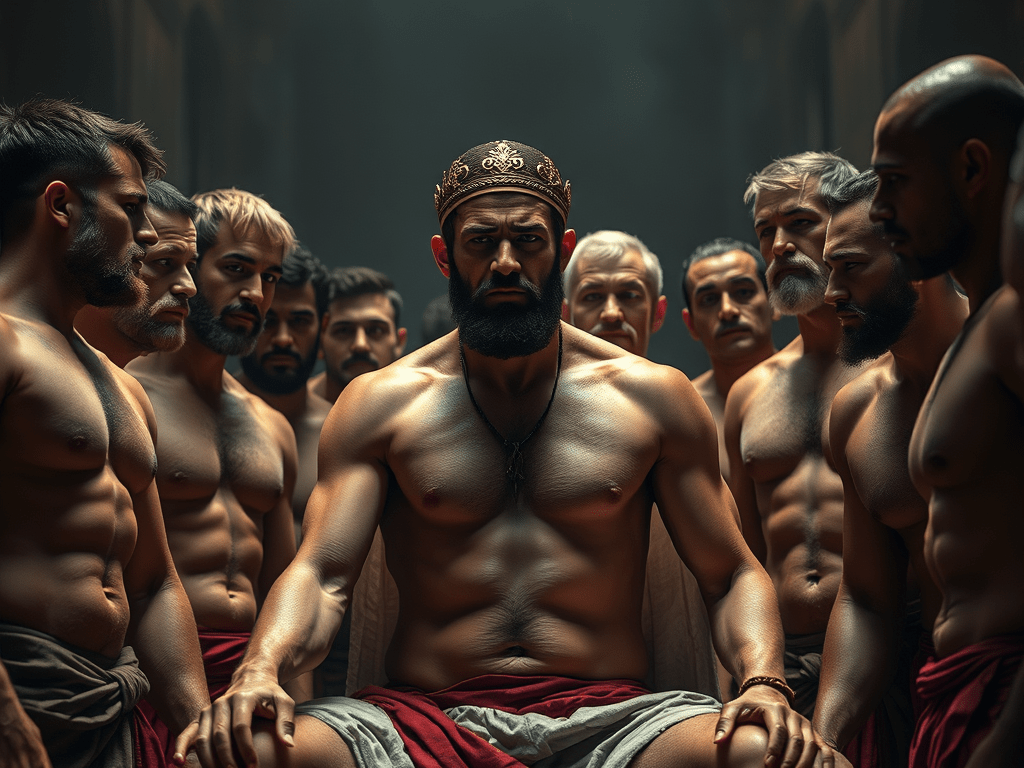
Castration anxiety is a main factor in the crisis of masculinity but this is not resolved by toxic masculinity. It is the very opposite: toxic masculinity amplifies castration anxiety; it is castration anxiety on steroids (“the smaller your balls are, the bigger your dick looks”). The lack of embodied labour is now compensated by body-work in the name of fitness. The suffering body of work has now become the aestheticized body on display; amplifying the visual pleasure of admiration and being admired. The fit male body is a crucial medium of the homo-sociality of toxic masculinity. The very notion of “the chad” represents this ego-ideal.
Castration anxiety not only affects incels. It also affects “world leaders”. At the lasts NATO summit in The Hague (June 2025) European “world leaders” and especially the NATO Secretary General Mark Rutte were displaying a sickening theatre of sycophantry around the president of the USA. They venerated him as the Daddy-Führer, because they believed that this would make them their friend. The problem is that Trum himself is also a sycophant and like them, he worships “strong men” such as Putin, Kim Jong Un, Benjamin Netanyahu and Xi Ping, who of course despise him for that. As a European, it makes me feel ashamed. Why have we picked the worst, the dumbest, the most narcissistic, the least self-aware, the most disgusting Daddy-Führer?
The mouthpieces of sycophantry in the public sphere – most notably politicians, journalists and pundits – act as if it is completely normal to keep on praising the emperor without any clothes. They are the lubricants of obscene masters that spear-head the spread of kakistocracy. By pretending that the emperor is wearing clothes, they also assume that we cannot see that the obese old man is actually naked. What is most infuriating is not the projected assumption that we should not believe our own eyes, but that exactly by being empirical and logical, we are disqualified from pointing out that the emperor is naked.
For example: empirically speaking there is an ongoing genocide in Gaza. Logically, this genocide is the product of Zionism, whose establishment of a Zionist state owes its success from the long history of European antisemitism, which had been instrumentalized throughout the centuries, as a means for states to divide and conquer. That is, the birth of Zionism, in an age where nation-building was concerted effort to consolidate state-power (in the hands of the bourgeoisie), is due to a rampant cultivation anti-Semitism by those who had a strong interest in nation-building. That Zionism expressed exactly the same interest in nation-building, deploying the same myths around “Volksgemeinschaft”, logically explains the empirical evidence that Zionism shares the same assumptions as anti-Semitism. It also explains why Zionism is most ferociously critical of diasporic Jews who reject this ideology either on religious or moral grounds. It also explains why one does not need to be Jewish at all, to support Zionism. It even explains why most of those who operate on the right side of the political spectrum, many of whom hold deeply anti-Semitic convictions, support the Zionist Project.
However, pointing this out is automatically condemned by Zionists and real anti-Semites alike, as anti-Semitic. Not only that, expressing such views are defined as anti-Semitic hate speech. One is not merely being gaslighted, one is being criminalized and silenced. This, however, is also both empirically and logically proven. Any attack on Zionism is also an attack on the very organizing principles of Ethno-Nationalism that are deeply rooted in the foundations of Western Imperialism.
In a book review of the German Translation of “On Settler Colonialism: Ideology, Violence and Justice” written by Adam Kirsch, Alfred Bodenheimer repeats the main argument of the book, that the term “settler colonialism” has been misused to delegitimate states in which the “settlers” have become the majority. Bodenheimer specifically denounces the victimology of indigenous people as it suggests the notion that once there was an originary, territorially bound, ethnic group to whom the land belonged.
It is clear why Alfred Bodenheimer, writing this Book Review for German-language “newspaper”, the Jüdische Allgemeine, would embrace any pushback against a critique of settler colonialism. Kirsch wrote his book as a reaction to the way in which – according to him – “October 7” has sparked a widening interest in a critique of settler colonialism, which is being used to delegitimate the Zionist Project. Zionist authors seem to have an image tatooed in their memories of American studets cheering and celebrating the Hamas attacks. Although the New York Post (hardly a quality newspaper) did mention a few individual academics justifying the attacks by Hamas, they were not celebrating it. Perhaps Bodenheimer and Kirsch were thinking of Israeli settlers in the West Bank celebrating the burning alive of a Palestinian baby (for which some of them were later convicted in court)?
Like Kirsch, Bodenheimer rejects the victimology of people who claim to be indigenous and feel aggrieved that their means of existence have been violently taken away from them. Kirsch clearly seeks to market himself as an apologist of genocide and Bodenheimer applauds him for that. What is weird, however, is the complete lack of critical self-reflection. Is the Zionist project itself not based on a claim to indigeneity of the “Promised Land”? Is the logic that one is entitled to use violence to territorialize one’s own ethno-nation state not a justification of the existence of Hamas? Or is the genocide of indigenous peoples to create a majority ethno-state that then no longer deserves to be called “a settler colonial state” irrelevant because history does not matter?
Kirsch rightly identifies the critique of settles colonialism as undermining the self-evidential legitimacy of any form of nationhood. Exactly, the legal justification of colonialism was rooted in European imperialism that become consolidated in the invention of “sovereign nation states”. Colonies were of course never sovereign nation-states, so they had no legal anchoring of a relationship between territory and nation-hood. By accidentally exposing the arbitrariness of nationhood, Kirsch’ book becomes – de facto – a justification for every act of violence performed in the name of national self-determination. The only thing that would allow him to reject certain forms of violence (obviously labelled “terrorism”) if they are performed by racial groups that stem from the colonies, not those that think of themselves as the “white masters”.
Bodenheimer never mentions the Nakba, which is by all legal defintions a process (not an act) of ethnic cleansing and genocide. The white-washing of racist crimes against humanity may alleviate men like Kirsch and Bodenheimer of their sense of guilt. They may denounce critiques of settler colonialism as historically flawed and inappropriately moralistic. However, their main motivation seems to be to ensure that this critique never reaches the core of the Zionist Project and is not articulated in terms of war crimes against Palestinian people. They main tenets of these kinds of publications have nothing to do with either empirical evidence or logic. They are themselves exercises in moralization, victimology and historical revisionism.
 Disaffected Sociology
Leave a comment