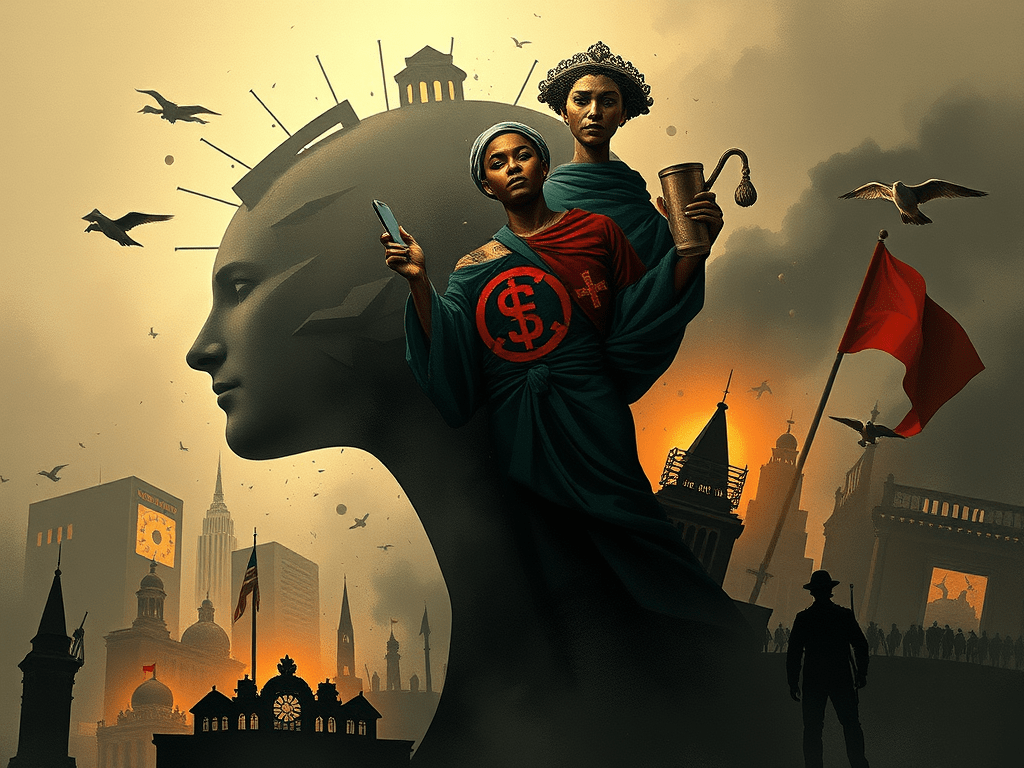
Despite decades of ongoing, unresolved debates among feminists about how conceptions of patriarchy and capitalism should be related to each other, there seems to have emerged a general agreement that both are best understood through analytical frameworks that are attuned to both historical as well as materialist principles. Of course, there are many feminist analyses that have very little to do with capitalism, but these often fail to either address the historical specificity of patriarchal forms or their pertinence in the face of ideological volatility. It is hard to take any critical analysis of patriarchy seriously, if it does not address its historical unfolding as a pertinent and durable material force.
However, the reverse also applies. It is hard to take any analysis of capitalism seriously, that does not take into account patriarchy as a nexus that enforces particular life forms in which the majority of women subordinate their own needs to the needs of the majority of men. That is, any analysis of capitalism that fails to take into account the gendered character of manual and intellectual labour and does not acknowledge that gender is also affected by real abstraction, seems to be inadequate to explain how it works.
Thirdly, neither capitalism nor patriarchy can be understood either historically or materially if we restrict ourselves to notions of society that happen to coincide with the territoriality of the nation state. The adjective “imperialist” is essential because, as a set of violent practices of military, political, legal, technological, economic, cultural and libidinal imposition, imperialism structures and shapes the life forms that have evolved under capitalism and patriarchy. By extension, we cannot understand imperialism without also acknowledging the formative impact of (proto-) capitalism and (Christian) patriarchy.
These three thoughts feed into Raj Patel’s and Jason W. Moore’s World History in Seven Cheap Things (Verso, 2018) in which they advocate to replace the term “Anthropocene” with that of “Capitalocene”. They thereby expand the term capitalism as more than an economic system (let alone an ideology, which is how many stupid Americans now use the term) but “as a way of organizing the relations between humans and the rest of nature” (ibid: 3), which, incidentally, is also something we must immediately reject as well. Separating humans form the rest of nature is the work of intellectual labour that is derived from real abstraction but fails to acknowledge that. Just as commodity-fetishism implies the obfuscation of the process by which labour and social cooperation are embedded in commodities, making commodities appear to have intrinsic value and power independent of the human labour that produced them, so may we understand humanity-fetishism as the obfuscation of the process by which material-energetic-informational metabolisms are embedded in all life forms, making humans appear to have intrinsic value and power independent of the metabolic relationships that engendered them. The relationship between labour and metabolism is not one of analogy, instead labour is a specific form of metabolism; it is part of the ecological nexus that we have learned to call “nature”.
Conceiving capitalism as a particular historical configuration of metabolic relations does not replace the more traditional understanding of capitalism as a mode of production. However, we do need to acknowledge Émilie Hache’s distinction between production and generation, as it highlights how – as part of the unfolding of Christianity in Europe – the former has come to increasingly replace the latter. Capitalism as a mode of production is the culmination of this. It does not, however, prevent a conceptualization of that which it overshadows: a mode of generation (or engendering).
To think of modes of engendering that exist in the shadows of capitalism is not to be understood as a quest for salvaging something worth dying for. We simply do not yet know what it might be. Bruno Latour once gathered a collective of authors to write An Inquiry into Modes of Existence as a follow up to We Have Never Been Modern. Modes of Existence and Life Forms do indeed suggest a notion of oikos that is not reduced to economics. Aristotle himself used οἰκονομία (economy) to refer to the generic organization (nomos) of households (oikos) as distinct from chrematistics – χρηματιστική (chrēmatistikē) – with chrēma meaning useful thing, money or property and the postfix –istikos meaning “the art of” (or the science of). The reduction of oikos to the art of (handling) useful things (including money) thus took place in spite of Aristotle’s distinction. Hache associates this with early Christinianity, but one might wonder to what extend her understanding of Christianity has been affected by reading Weber’s Protestant Ethic (and the peculiar emphasis placed therein on the parable of the talents) as within Catholicism, the “economy of salvation” only became associated with monetary indulgences in the late medieval period when money became a more standardized form of dealing with debt. Before that, Catholicism had a very ambivalent relationship to chrematistic thinking; which was much more pragmatically incorporated into Roman Law, rather than, say, the life of the early church.
However, the idea of a shift from thinking oikos in terms of generation to thinking oikos in terms of production already presupposes a notion of real abstraction, namely on that is able to quantify debt; which is money, and in particular coinage. Chrematistics is only possible because one is able to abstract “value” from “use” in relation to property. Use, value, property and money are all associated with chrema, and the –istics is then a very specific art/science, namely one that is derived from quantification and calculation. Abstraction is a skilful practice.
The universal materiality of chrematistics is coinage. The reason why coins were an effective means of quantifying debt in Athens was because Athens had control over the Laurion silver mines in southeastern Attica, about 50 km from the city. The wealth of Athens was derived from its ability to use mint coins. For example, in Poroi, Chapter 4, Xenophon wrote the following: “The silver mines of Laurion, which have never failed to yield revenue to the state, still hold much promise. For, though worked for many years, they are still productive, and many new veins are being discovered. If more laborers were employed, the returns could be greatly increased. The state should therefore take care to acquire more slaves and let them out to work in the mines on a share basis.” (Xenophon, Poroi, 4.14–17). What we must therefore acknowledge is that the unfolding of the Western Metaphysical Tradition with the advent of Greek Philosophy, coincided with a transformation of the handling of matter – from generation to production – and with it an abstraction of the social relationships not only of labour but also of care, oikos was always-also a realm of generation and regeneration. What we must also acknowledge is that the growing dominance of chrematistics involved military force and violence, not merely in terms of territorialisation but also in terms of extracting labour power through slavery. The Western Metaphysical Tradition has always been engendered by a spirit of imperialism. Finally, we must acknowledge that this transformation has been slow, incomplete and non-linear.
 Disaffected Sociology
Leave a comment