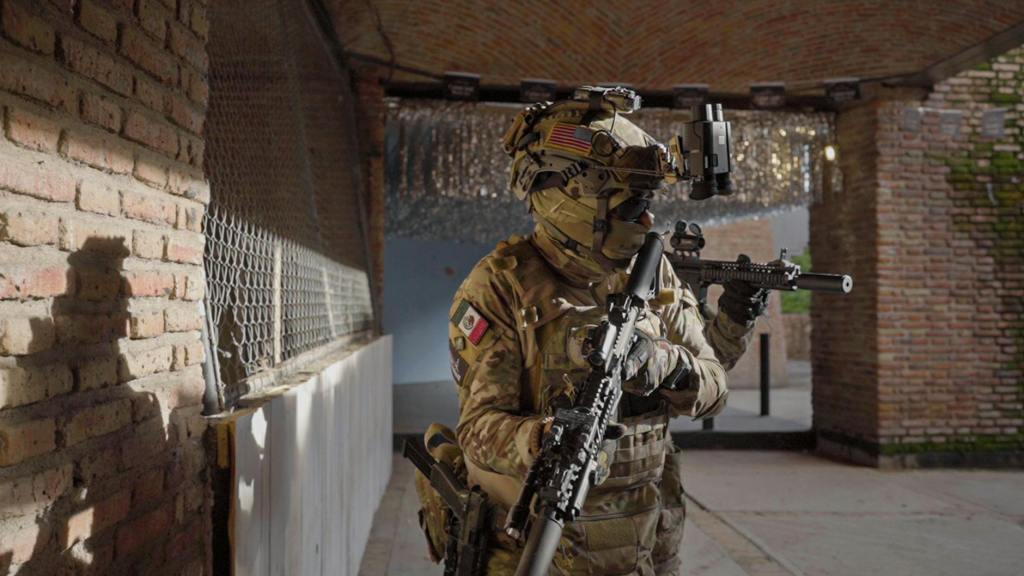
It is now several months after nations in Western Europe have declared to increase their spending on “defence”. Is there any army in the world that is officially labelled “offence”? It is such an obvious point, that we may actually fail to notice its significance. The universal preference for “defence” reflects a discursive regime where violence is legitimized by the claim of necessity. It’s a core mechanism in the moral economy of modern statehood. Calling it “defence” transforms domination into duty, and aggression into protection.
This cuts to the core of sovereign power. Whereas it requires the exercise of violence to maintain its sovereignty, it can only do so on the basis of claiming the primary identity of “victimhood” for itself. The notable exception is the deployment of state violence to “protect” other victims; then the main identity to be adopted by that state is that of “saviour”. The third identity in this transactional triangle – the perpetrator – is always the object of state-violence.
During the 1970s, the term “terrorist” became a beloved label used by states to define perpetrators. In the early days, terrorists were never states but small groups operating within states. There were two main types of terrorists: (a) groups operating in the name of the liberation of a repressed minority (such as the PLO in Israel, the IRA in Northern Ireland, ETA in Spain, or the PKK in Turkey); and (b) groups operating in the name of a radical ideology such as the RAF in Germany, the Red Brigades in Italy or the Shining Path in Peru. In all these cases, the violent actions labelled “terrorism” were directed against powerful states, that themselves used violence, for example in the repression of certain ethnic minorities (Palestinians in Israel and the occupied territories, Irish Catholics in Ulster, Basks in Spain or Kurds in Turkey); or in the repression of certain forms of politics (primarily those associated with revolutionary Marxism – e.g. Leninism and Maoism).
This all changed with the advent of so-called “Islamic Fundamentalism” in the 1980s after the Iranian Revolution. The label terrorist was transformed into an ethnic category. Terrorists were increasingly reduced to an ethnic category (“Arab”) which not so incidentally coincided with what people like Benjamin Netanyahu had been propagating during the 1970s: All Arabs are terrorists because of their genetic-mimetic composition. The PLO was not a particularly religious organization and its political orientation was more socialist; the invention of Hamas In the mid-1980s enabled a discursive construction of perpetrators that accomplished two things at once: (1) a dissociation between the “Palestinian question” and wider issues of social justice; and (2) a splitting of the Palestinian political movement into a progressive and a fundamentalist wing. The latter was actively supported by Israeli and US political forces, which –as all good “democratic” nations have done before them – consider communism a greater evil than fascism. (As fascism is merely the “bad cop” of capitalism.) The US support of Al Q’aida in Afghanistan during the 1970s had very similar interests at heart. Whereas the ideology of Islamic Fundamentalism may be rooted within Islam itself, its rapid militarization has been completely enabled and financed by “Western” interests.
In a sense, “Islamic Terrorism” is a story of chickens coming home to roost and could be compared with a runaway event as a result of an accident in a biological warfare laboratory. Of course, many people who are drawn to religious ideologies such as that of Salafism are not those who live in luxury and wealth. Salafism appeals to the “wretched of the earth” exactly because the latter have nothing to lose anymore. Only the most radical solutions then seem to still provide a realistic chance of improvement.
Facing with a runaway event of its own making, western “democratic” state rhetoric had to quickly change its narrative. Islamists, as former allies in the cold war, now had be quickly rebranded as “evil terrorists”. Their motivation to commit terrorist acts such as those of 9/11 is irrelevant. They are simply genetically and/or mimetically “evil” people because they have bene indoctrinated by “evil” doctrines, also because they are culturally more susceptible to them (as centuries of Orientalism had taught us).
It was Israel that could play a prominent role in this narrative, as their “terrorists” had both the old (PLO) and the new forms (Hamas/Hezbollah). The continuity between was simply “Arab” (Palestinians are rarely called Palestinians in Israeli public discourse as this would be an admission that there might be or once might have been a state called Palestine). This bridge enabled an easy re-articulation of Terrorism as “bad things that Arabs and Muslims do”.
 Disaffected Sociology
Leave a comment