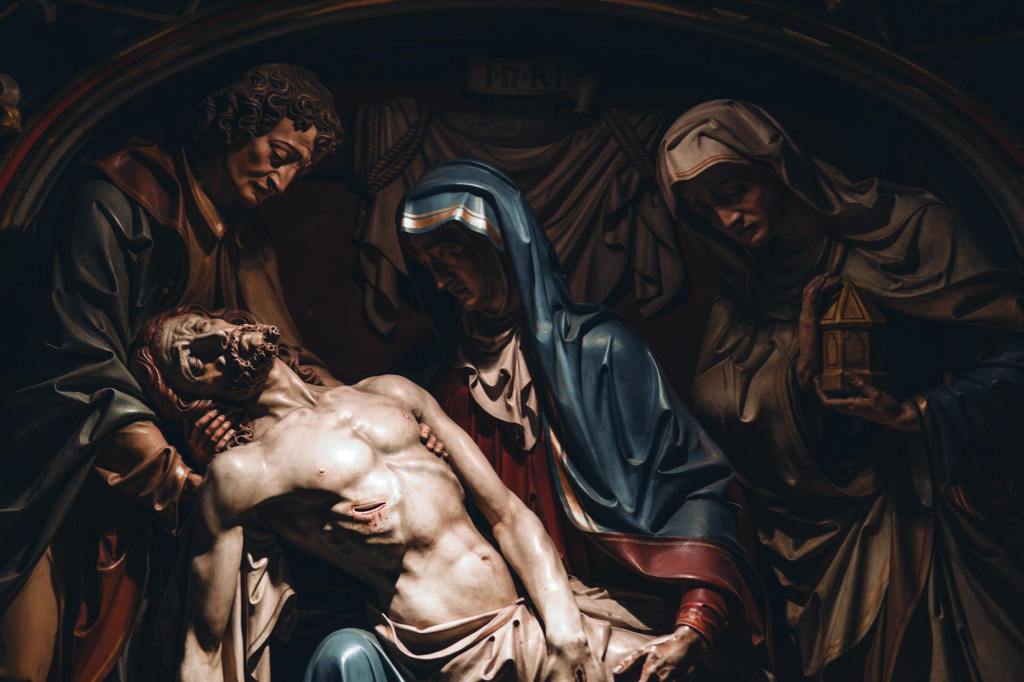
It is quite logical to connect the concept of kenotic solidarity to those of alienation (Marx) and decreation (Weil). For Marx, alienation appears first as an obstacle to solidarity, because one misrecognizes one’s relationship to labour and to humanity. However, without alienation, there is also no dialectical moment of proletarianization. And without that moment, we cannot come to terms with real abstraction as experienced. In a similar vein, Weil argues that without suffering self-emptying, we cannot receive grace.
Having asked Gemini to write a reflection on cross-reading Karl Marx’s conception of alienation and Simone Weil’s conception of decreation as a means of philosophically grounding kenotic solidarity did not produce the stunning integrated overview that I had hoped for. It seems to me that Gemini is desperate to provide a humanist angle by mistaking, for example, Marx’s third dimension of alienation (Gattungswesen) for an individual condition within the person. Instead, in his critique of Feuerbach, Marx made it explicitly clear that this was one of Feuerbach’s main mistakes. Marx never understood human, subjective praxis as belonging to the individual. Instead, he insisted that humanity was a “vergesellschaftete Menschheit”.
If Gemini did this to Marx, then of course it also did this to Weil. Simone Weil’s work should be understood as an exercise in performative political theology rather than moral theology. She analyses how to understand “grace” as bestowed in relation to affliction (malheur). This is not an advocacy of self-harm, nor a glorification of suffering.
Reading décréation performatively repositions it: not as withdrawal from the world, but as a counter-sovereign praxis—a refusal to participate in the dominant logic of power, self-assertion, and identity-formation that grounds modern political subjectivity. In this frame, décréation becomes: (a) a deliberate unmaking of the political subject, which resists the state’s demand for legibility, utility, and affirmation; (b) a refusal to stabilize the self in a form that can be governed, categorized, or mobilized by systems of power; (c) a performative exposure of the violence implicit in the making of subjects in liberal-capitalist regimes.
In this light, the body—especially the suffering, hungry, or silenced body (which Weil knew intimately)—becomes a site of resistance, not passivity. Décréation is not quietism; it is a liturgical defiance enacted through bodily vulnerability. This makes her kin, surprisingly perhaps, to thinkers like Judith Butler (on vulnerability, grief, and precarity) and Giorgio Agamben (on bare life and the threshold of the political, for which he invoked the notion of destitutive power). The decreated body performs its refusal: (a) by becoming unproductive in capitalist terms; (b) by withdrawing from identity categories; and (c) by staging an ethic of exposure and non-mastery.
In a performative political-theological frame, Weil’s décréation proclaims the impossibility of sovereignty as such—divine or human. God, in her thought, must also withdraw (a kind of divine decreation) for the world to exist. This symmetrical kenosis—divine and human—is deeply unsettling to any stable notion of power, including divine omnipotence. It’s a mutual undoing of power, a choreography of absence, where neither God nor the subject occupies the throne. This resonates with radical political theology (e.g., in the wake of Schmitt, Taubes, or Derrida) that dismantles the metaphysical foundations of law, order, and statehood.
What then of obedience? In a moral theological frame, it is submission. But in a performative political-theological one, it can be anarchic allegiance to an absent center, a loyalty to what exceeds power itself. This is not compliance—it’s mystical insubordination. To obey God in Weil’s sense is to refuse every worldly power that claims to speak for God. In that way, décréation becomes a sacrificial unmaking of all idols, including the idol of the political self, and a refusal to grant finality to any human order—state, law, ideology. Indeed, in this sense, Weil’s decreation is an inspiring alternative to Hegelry.
With the performative political theology of Weil, we can defy Staatsräson and its reliance on the assumption of the primacy of self-preservation in identity thinking. We can indeed recognize Palestinians as the strangers within ourselves; the ruins of Gaza—be they buildings or bodies—are the wounds of our complicity in genocide. They are our affliction. The adulation of the deceptions of “freedom” and “self-defence”, which justify brutality in the name of democracy, while those representing the state always ensure that others will suffer at their expense, is being exposed for what it is: a twilight of idols.
Of course, there are massive differences between Marx’s historical materialism and Weil’s performative political theology. Marx anchors his analysis in the brutal reality of capitalist exploitation; alienation is engendered by real abstraction. By contrast, Weil’s method is contemplative and meditative. However, both recognize the inevitability of suffering and sacrifice because of the corruptive practices of state power and the violence of self-valorization.
While Artificial Intelligence bots regurgitate the cacophony of liberal doctrines that pollute and corrupt honest analysis—because they are ultimately working in service of those who benefit from it—kenotic solidarity can engender new life forms that subvert domination and sovereign imaginaries.
 Disaffected Sociology
Leave a comment